
Building and Sustaining Collective Leadership
- Create an artefact that captures key leadership knowledge, skills and attributes necessary for building and sustaining collective leadership in education.
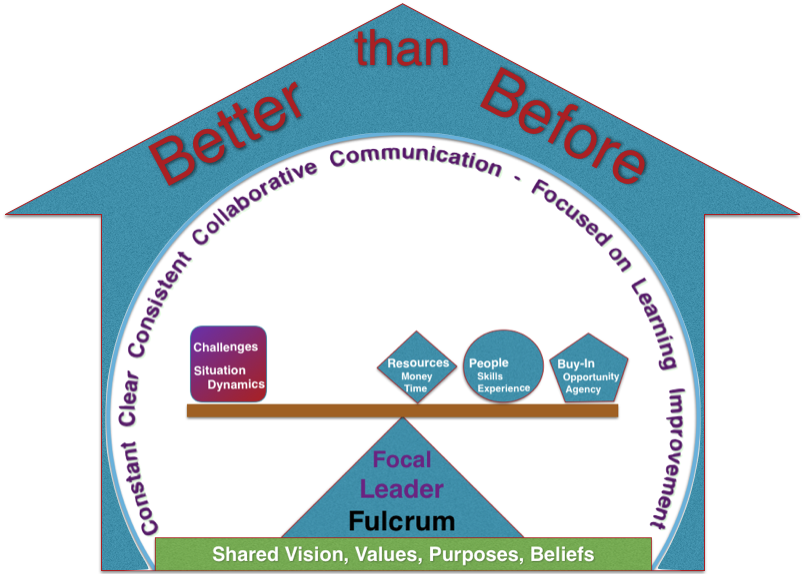
Our Shared Vision, Values, Purposes and Beliefs are the foundation that underpins everything in our school.
The focal leader is the fulcrum on which the challenges and resources are balanced - the fulcrum moves laterally to ensure these are counter-balanced.
Organisations, no matter how big or small, do best with one leader. Distributed leadership is a fine and effective model, but there needs to be one person with whom the ‘buck stops’.
This was amply evidenced at a school I took over where there was officially one principal and four co-principals. The four co-principals were supposedly principal for one day a week each, the principal ‘owning’ the fifth day (and the salary).
In practice this resulted in some very serious situations not being dealt with appropriately, and not being communicated to anyone else, because the ‘principal on the day’ didn’t feel it necessary to share.
The end result of that was a number of families utterly devastated when serious sexual misconduct occurred - at a time when two of those families were already suffering severe trauma for other reasons.
The Founding Fathers of the United States knew there had to be distributed leadership to sit alongside the One President model. That distributed leadership took the form of the other two branches of government - the Senate and Congress.
The President is the fulcrum leader but major decisions must be approved by the other branches of government.
The C’s that sit within the boundary of the dome - Consistent Clear Collaborative Communication - surround the foundation, the fulcrum leader, the challenges and the resources.
Those C’s of Communication bounce off the walls of the dome and travel back and forth within the dome in all directions. It is multi-directional and in this way simulates a flatter leadership model.
Everyone is party to the communication. Everyone is contributing to the communication, everyone is in the loop.
On the seesaw we have two sides of an equation. Any mathematical equation must be balanced. The same is true for challenges and situation dynamics. The inputs required to meet those challenges need to be sufficient to balance them and keep everything ‘on the level’, in harmony and on track. The challenge for the fulcrum leader is to achieve that balance by moving the point of fulcrum as necessary - putting in additional resources, recalibrating programmes and initiatives, providing extra Professional Development, managing time constraints, prioritising needs, ensuring personnel are nurtured and able to cope.
All of these elements within the dome are directed towards learning improvement, including catch-up learning, accelerated learning and learning extension.
The dome - containing the C’s of communication, the challenges and resources, the fulcrum leadership and the foundation vision, values, purposes and beliefs - itself sits of a moving platform (consider it a travelator or a magic carpet or similar) that takes us towards our preferred future as a whole learning community. That preferred future is expressed as “Better Than Before”.
We choose this as our preferred future because our vision, values, purposes and beliefs has us on the right path. Better Than Before ensures we never sit still on that path. That whether we consider we are leading the way, exhibiting GRIT in the Pit or striving for clarity, we can always improve on our current situation and achievements. We are not striving to be the best, but to be our best.

Response from Gretchen Cocks - C2P:
Collective Leadership
I read your Building and Sustaining Collective Leadership post with interest. I agree that distributed leadership and elements of it are very important. Too much, can lead to ‘too many chiefs’. There does need to be a focal leader with a strong vision. On the other hand, that focal leader with the strong vision also needs to have very clear communication skills and their thinking needs to be visible to staff. When the focal leader does not communicate or is not transparent in where the organisation is heading, this can lead to frustration, irritation and lack of trust. The focal leader needs to achieve the fine balance of when to make a decision and when to consult and collaborate with others. Although the leader is where the buck stops, they need to have strong relationships with their senior leadership team because when a focal leader makes all the decisions without input or ideas from others, it becomes a one-man band. I agree the 4 cs of consistent, clear, collaborative communication is vital. You have captured the role of the focal leader well in your piece when you talk about proactively monitoring the needs of the school and providing the resources, time, development and nurturing, to meet the needs of the teachers who are the backbone of a school while allowing others to develop and grow their own leadership abilities.

- Create an artefact that captures key leadership knowledge, skills and attributes necessary for building and sustaining professional communities in education.
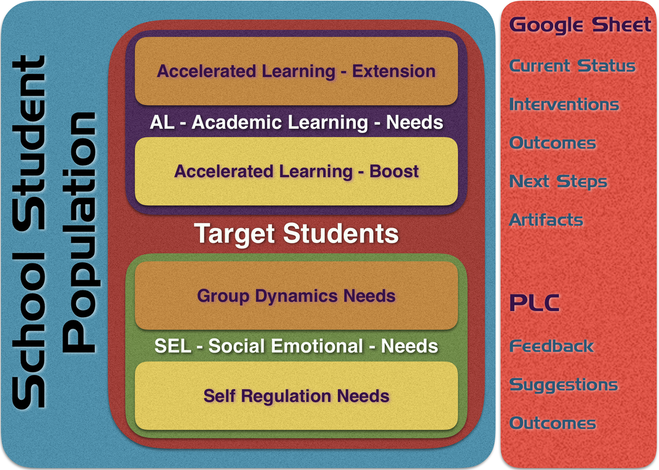
In this instance we are looking at a Professional Learning Community within our school rather than across schools.
The focus for our PLCs are our Target Students.
There are two areas we focus on, and two sub categories for each;
We track our Target Children on Google Sheets:
PLC Feedback and Reflection Principles:
Within our PLC Apply a GROWTH Coaching Process:
Coaching is now recognised globally as a powerful intervention that can support educators and learners (Campbell, 2016; Knight & van Nieuwerburgh, 2012; van Nieuwerburgh, 2012; van Nieuwerburgh & Barr, 2017).
Teachers work in pairs within their PLC.
The focus is on personal growth and learning.
Coaching is “a managed conversation that takes place between two people,” that it “aims to support sustainable change to behaviours or ways of thinking,” and that it “focuses on learning and development” (van Nieuwerburgh, 2017, p. 5).
A one-to-one conversation that focuses on the enhancement of learning and development through increasing self-awareness and a sense of personal responsibility, where the coach facilitates the self-directed learning of the coachee through questioning, active listening, and appropriate challenge in a supportive and encouraging climate. (van Nieuwerburgh, 2012, p. 17)
Coaching in education can be a powerful way of empowering learners, increasing engagement, and creating positive learning cultures.
Peer coaching is used in other contexts to denote a reciprocal relationship between two colleagues (Foltos, 2013; Robbins, 2015; Robertson, 2008).
In this case, both educators can be peers with neither one required to be an expert in specific teaching practices. In peer coaching, teachers work together to discuss areas of development that might lead to improvements in classroom practice. Usually, the teachers plan lessons together or decide on changes to classroom practice. This is followed by the new practice being trialed in the classroom before reconvening to reflect and evaluate the success of the lesson plan or new practice. Peer coaching is one way of providing cost-effective support for educators to improve teaching practice in classrooms (Kidd, 2009). It is also suggested that such approaches can enhance the development and well-being of both partners (Robertson, 2008).
The focus for our PLCs are our Target Students.
- Target Students are children Not Achieving or At Risk of Not Achieving.
There are two areas we focus on, and two sub categories for each;
- Academic Learning
- Accelerated Learning where a Boost is needed to achieve expected standard
- Accelerated Learning where Extension is needed to achieve potential standard
- Social Emotional Learning
- SEL focused on Self Regulation
- SEL focused on Group Dynamics - regulation within group situations
We track our Target Children on Google Sheets:
- Current status - the Now
- Desired Status - the Now Plus One - N+1 - Next Step
- Planned interventions
- Timeframe - Checkpoints
- Outcomes
- PLC Feedback and Reflection
- N+1
- Planned Interventions
PLC Feedback and Reflection Principles:
- Honesty Always
- No Blame
- No Idea is Foolish
- We Are All Equal - our ideas are of equal merit
- One Size Fits One - each child needs a plan for them
Within our PLC Apply a GROWTH Coaching Process:
Coaching is now recognised globally as a powerful intervention that can support educators and learners (Campbell, 2016; Knight & van Nieuwerburgh, 2012; van Nieuwerburgh, 2012; van Nieuwerburgh & Barr, 2017).
Teachers work in pairs within their PLC.
The focus is on personal growth and learning.
Coaching is “a managed conversation that takes place between two people,” that it “aims to support sustainable change to behaviours or ways of thinking,” and that it “focuses on learning and development” (van Nieuwerburgh, 2017, p. 5).
A one-to-one conversation that focuses on the enhancement of learning and development through increasing self-awareness and a sense of personal responsibility, where the coach facilitates the self-directed learning of the coachee through questioning, active listening, and appropriate challenge in a supportive and encouraging climate. (van Nieuwerburgh, 2012, p. 17)
Coaching in education can be a powerful way of empowering learners, increasing engagement, and creating positive learning cultures.
Peer coaching is used in other contexts to denote a reciprocal relationship between two colleagues (Foltos, 2013; Robbins, 2015; Robertson, 2008).
In this case, both educators can be peers with neither one required to be an expert in specific teaching practices. In peer coaching, teachers work together to discuss areas of development that might lead to improvements in classroom practice. Usually, the teachers plan lessons together or decide on changes to classroom practice. This is followed by the new practice being trialed in the classroom before reconvening to reflect and evaluate the success of the lesson plan or new practice. Peer coaching is one way of providing cost-effective support for educators to improve teaching practice in classrooms (Kidd, 2009). It is also suggested that such approaches can enhance the development and well-being of both partners (Robertson, 2008).
|
The Growth Model:
The GROWTH model can be considered a form of scaffolding that supports the coachee to explore ways of undertaking meaningful change.
Campbell, John. The Leader's Guide to Coaching in Schools (pp. 33-34). SAGE Publications. Kindle Edition. 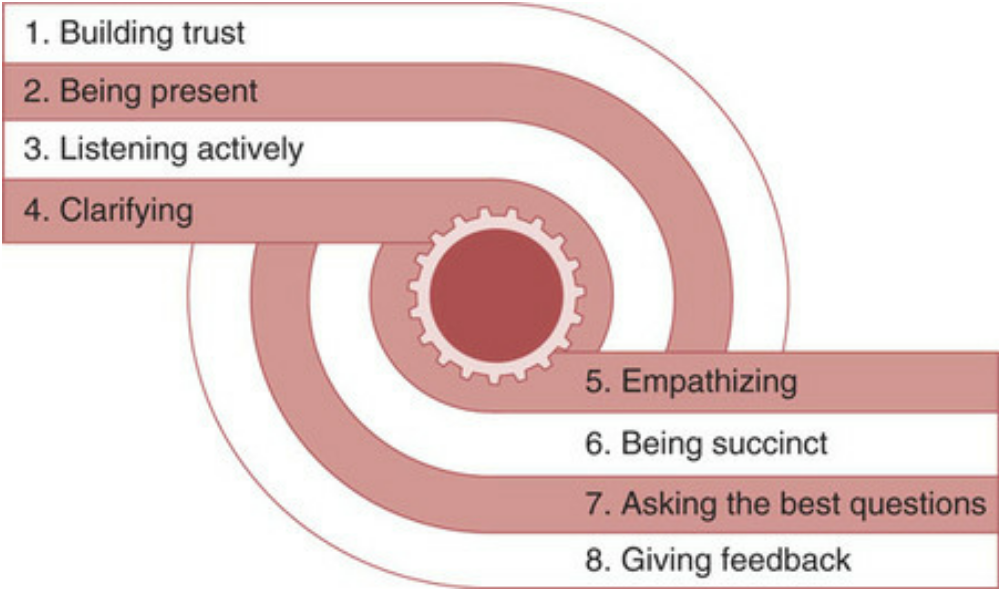
Creating a Coaching Culture
Culture is a word used often in everyday interactions. According to Edgar Schein (2010), culture is a “pattern of shared, basic taken-for-granted assumptions . . . that manifests itself at the level of observable artifacts and shared espoused values, norms, and rules of behaviour” (p. 32). When considering cultures in educational settings, Nuri-Robins, Lindsey, Lindsey, and Terrell (2006) have defined culture simply as the beliefs and practices shared by a group. The use of coaching with professionals is a positive way of supporting their growth and development and of supporting a learning through the vehicle of coaching. A coaching culture can lead to changes within an organisation that are experienced positively by everyone concerned. Positive outcomes for learners, educators, parents, and members of the educational community. Conclusion: In a meta-analysis of all quantitative studies undertaken until 2016, it has been suggested that coaching interventions can have significant positive effects on performance, skills, well-being, coping, goal attainment, and attitudes to work (Theeboom, 2016). |
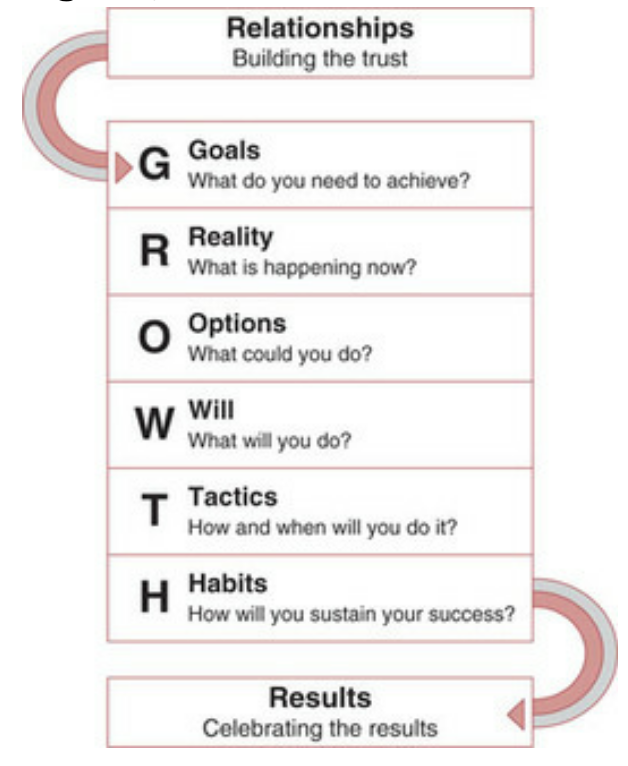
The Coaching Way of Being
Campbell, John. The Leader's Guide to Coaching in Schools (p. 32). SAGE Publications. Kindle Edition. 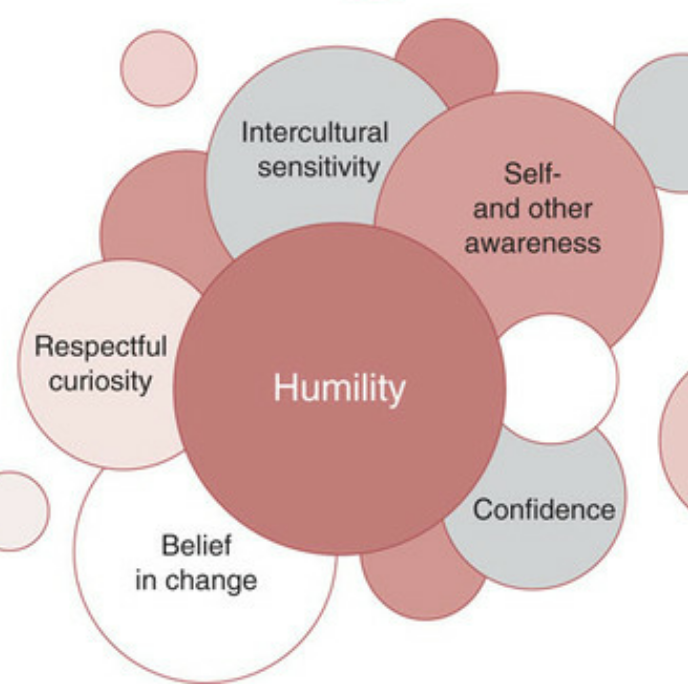
|
“It is often wonderful how putting down on paper a clear statement of a case helps one to see, not perhaps the way out, but the way in.” —A. C. Benson

Response from Gretchen Cocks - C2P:
Professional Learning Communities:
Leadership is an interesting topic, and one that is possibly no more heavily debated than in the context of schools. The concept of leadership within education is talked about in terms of distributed leadership, transformational leadership, transactional leadership and situational leadership - all verbs, and all used in one form or another at various times by school principals. One thing, however, remains constant, and that is, if you are a principal of a school or head of your organisation, regardless of what kind of leadership you are engaging in or utilising, you are the one who is responsible for the ship. This responsibility is carried whether the outcome is good or bad.
The reason that I raise this, is that it is important to understand because every decision that is made in the school, good or bad, comes back to me. Even at the classroom level. From my perspective, I promote and have various leadership roles across the school. The people in these roles have a high degree of autonomy within the parameters of their role. But, in providing this autonomy and in distributing leadership, I have first asked myself the following questions. 1. What is the risk involved in distributing leadership to this person or group? 2. What level of trust do I have in this person or group, within the parameters of the role that they will have? 3. What skills does this person or group have? 4. Am I prepared to support this person, should things go wayward? Similarly, when someone asks if they can do something in the school, be that for their class or for the whole school, I am also asking myself various questions before providing an answer. In most cases this comes down to three questions I ask myself 1. What are the risks involved? 2. What, if anything will this cost in terms of time and or resources? 3. Does this person have the skills to successfully carry out what they are proposing? I ask these questions of myself for one reason, and one reason only. Regardless of what happens, I am responsible for the ship. The decisions that are made within and across the school always - regardless of how small - come back to me. For anyone considering leadership roles within a school, or within the system, this needs to be understood. It also sits under the reason why I don’t call myself a leader, but rather call myself a boss. While the term leader is a noun and, by definition, is the person who leads (verb) or commands a group. It tends to be used more in the context of leadership (verb); the action of leading a group of people, and is seen as the opposite of being a boss. You would have seen the image where it states, “a boss says go, while a leader says let’s go.” From my perspective, the term leader is bestowed upon you by others with regard to the way that they see you relative to the context described above.

My Responses to Gretchen's Posts:
|
|